SOURCE-TRACEABLE PRODUCT RESEARCH
How to Compare Product Claims Across Instagram Reel Transcripts
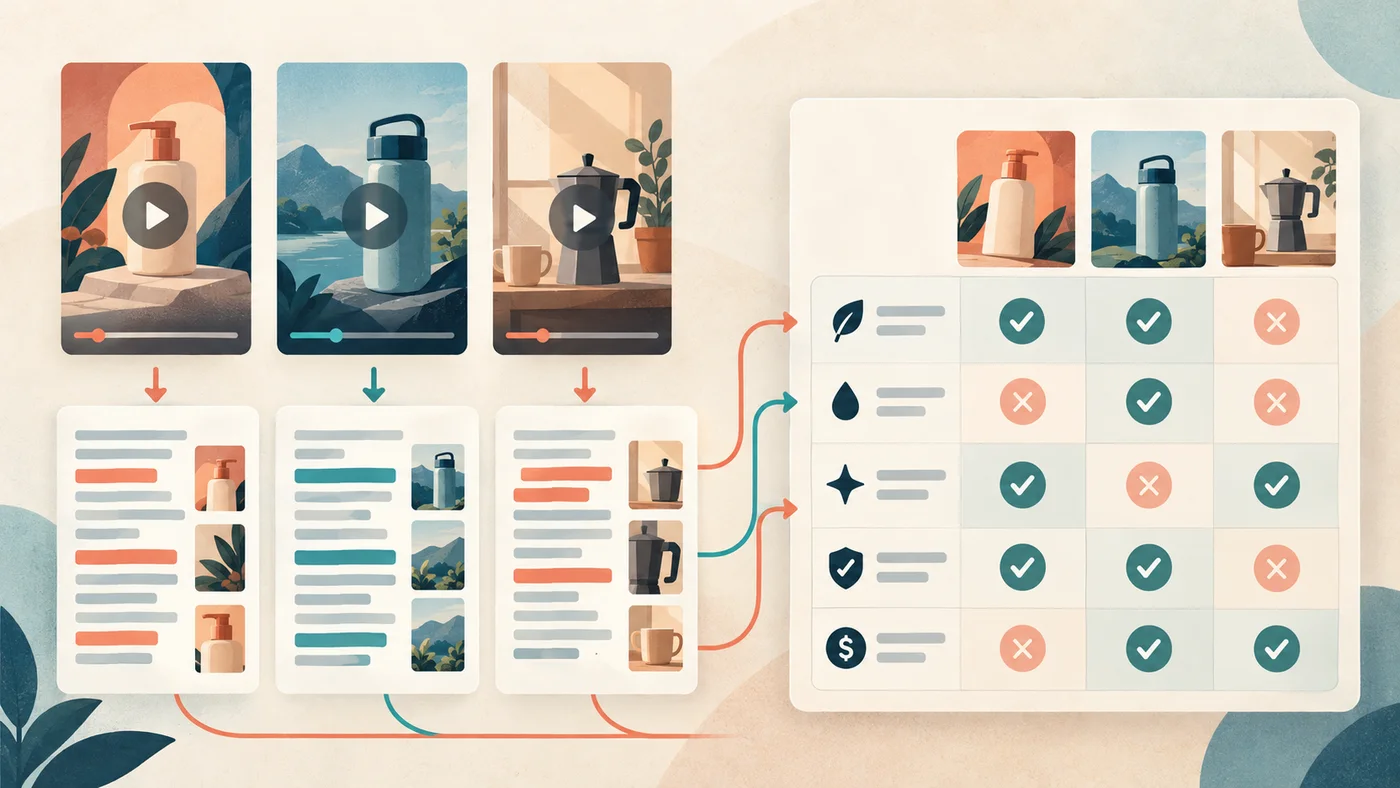
Transcribe and verify each Reel separately, reduce every product statement to one comparable claim, keep the speaker's conditions beside it, and record a passage or reviewed time marker before you compare. Mark missing information as not stated instead of guessing which product wins.
- 1
Create one reviewed transcript and source ID per Reel.
- 2
Normalize like-for-like claims in an evidence matrix.
- 3
Resolve conflicts against the source before drawing a conclusion.
CURRENT TOOL BOUNDARY
Process one Reel at a time, then compare the reviewed text
The current Instagram Reels transcript tool accepts one public Reel link or one uploaded media file at a time. It returns copy-ready text, a TXT download, and WebVTT when timing data is available. It does not identify products, verify marketing statements, or rank alternatives.
Keep transcription, claim extraction, and comparison as separate passes. This prevents an uncertain word in one transcript from silently becoming a clean-looking product fact in the final table.
DEFINE THE UNIT
Compare claims, not whole Reels
| Transcript element | Comparison treatment | Reason |
|---|---|---|
| Product identity | Record the exact spoken name after checking the audio. | A similar name can attach a claim to the wrong item. |
| Feature statement | Capture the feature and the object it affects. | Words such as faster or lighter need a clear reference point. |
| Measured result | Keep the value, unit, method, and condition together. | A number without its test context is not comparable. |
| Personal experience | Label it as the speaker's observation. | An experience is useful evidence, but it is not automatically a general product property. |
| Recommendation | Record the intended user and task. | Best for one situation does not mean best overall. |
| Promotion or price | Record the wording and source date, then verify elsewhere before purchase. | Commercial terms may change after the Reel is published. |
| Missing detail | Write not stated. | Silence is not evidence that a feature is absent. |
STEP BY STEP
Build the comparison from verified passages
1. Create a source manifest before transcribing
Assign each Reel a neutral source ID. Keep its public URL or owned-file name, the transcription state, and the review state in the same row. Use the multi-Reel queue workflow so one transcript cannot be mistaken for another.
2. Verify the passages that may affect the comparison
Replay product names, model names, negations, quantities, units, comparisons, and qualifying phrases. Follow the transcript accuracy checklist. Leave unclear speech marked for review rather than repairing it from memory.
3. Split compound statements into atomic claims
A sentence may mention a feature, a result, and a recommendation. Give each statement its own matrix row so one well-supported part does not make the other parts appear verified.
4. Preserve the claim type and speaker stance
Distinguish a direct observation, a quoted brand claim, an opinion, an instruction, and a prediction. Keep words such as may, usually, and in my setup because they control how strongly the statement can be compared.
5. Normalize the comparison field without rewriting the evidence
Put equivalent topics under one field name, such as setup, cleaning, compatibility, or return policy. Keep the original wording in a separate evidence column. Never convert two different measurements into a single ranking unless the basis truly matches.
6. Add the source route before interpreting the row
Record a passage ID or reviewed time marker beside every claim. If timing is important, use the timestamp workflow to recover the exact moment quickly.
7. Separate findings from purchase conclusions
First state what each Reel actually supports. Only then write a conclusion for a defined user, task, and condition. Treat price, availability, safety, warranty, and compatibility as items requiring current first-party verification outside the transcript.
ORIGINAL CLAIM SCHEMA
Give every comparison row an evidence route
| Field | What to enter | Release rule |
|---|---|---|
| Source ID | The neutral identifier from the manifest | Reject a row that cannot be tied to one Reel. |
| Product label | The checked spoken identity | Do not infer a model from visuals or context alone. |
| Comparison field | One shared topic | Use the same field only for genuinely comparable statements. |
| Claim type | Observation, brand claim, opinion, instruction, or prediction | Do not silently upgrade one type into another. |
| Evidence wording | The verified passage or a faithful paraphrase | Keep uncertainty, attribution, and conditions. |
| Source route | Passage ID or reviewed time marker | The reviewer must be able to recover the evidence. |
| Comparison state | Comparable, different basis, unclear, or not stated | Only comparable rows may support a direct contrast. |
| External check | The fact that needs current first-party confirmation | Do not present it as verified by the transcript. |
ORIGINAL FICTIONAL EXAMPLE
Compare two passages without declaring a winner
The practice passages and product labels below were written for this guide. They are not from an Instagram Reel, a product test, or a transcription run.
Practice source A

Passage A1: I could begin the first task after choosing the standard mode.
Passage A2: In my small workspace, I stored every loose part in one tray.
Passage A3: Check the maker's current compatibility list before ordering.

Practice source B

Passage B1: My setup needed one extra adjustment before the first task.
Passage B2: The pieces I removed fit in the case that came with my sample.
Passage B3: I have not tried it with older accessories.

Comparison draft

Field: first-use setup
Source A evidence: The speaker began after choosing a standard mode.
Source B evidence: The speaker reports one extra adjustment.
State: different personal observations; the tasks and conditions are not fully matched.

Field: storage
Source A evidence: Loose parts were kept in a separate tray.
Source B evidence: Removed pieces fit in a supplied case.
State: related but not equivalent; each passage describes a different storage arrangement.

Field: compatibility
Source A evidence: The speaker directs viewers to a current maker list.
Source B evidence: Older accessories were not tried.
State: no direct comparison. Current compatibility still requires first-party verification.
The draft preserves what is unknown. It does not turn two personal setups into a universal speed claim or treat an untested accessory as incompatible.
ORIGINAL DECISION MATRIX
Decide whether two claims can share a conclusion
| Question | If yes | If no |
|---|---|---|
| Do both passages identify the same product category and feature? | Continue to the measurement check. | Separate the claims into different fields. |
| Do both claims use the same unit or evaluation basis? | Continue to the condition check. | Mark different basis and avoid a direct ranking. |
| Are the relevant conditions stated for both sources? | Keep them beside the evidence. | Mark the missing condition and narrow the conclusion. |
| Is each statement a direct observation of the speaker? | Compare the observations with attribution. | Label quoted marketing, opinion, or prediction separately. |
| Can every normalized phrase be traced to verified wording? | Retain the row for review. | Restore the source wording or remove the interpretation. |
| Could the fact have changed since publication? | Check a current first-party source. | Keep the transcript evidence as historical context. |
COMPARISON DIAGNOSTIC
Repair the first unsupported handoff
| What you notice | Likely cause | Repair |
|---|---|---|
| One source seems more complete in every field. | Missing information was treated as a negative answer. | Replace inferred negatives with not stated. |
| Two values look comparable but use different units. | The matrix normalized the label but not the basis. | Keep the original units and verify a valid conversion or separate the rows. |
| A model name changes between transcript and table. | An uncertain word was silently corrected. | Replay the passage and leave the identity unresolved if the audio is unclear. |
| A personal result becomes a product guarantee. | The speaker stance was removed during paraphrase. | Restore attribution and the original conditions. |
| A recommendation has no defined user or task. | The conclusion is broader than the evidence. | State the intended use or remove the ranking. |
| A claim appears in the matrix but not the transcript. | Memory or outside knowledge entered the evidence column. | Move it to an external-check note or delete it. |
| A price or policy is presented as current. | The Reel was treated as a live product page. | Verify the current first-party source and record the check separately. |
| Several Reels repeat the same unsupported statement. | Repetition was mistaken for confirmation. | Keep each attribution but do not upgrade the claim without independent evidence. |
BEFORE YOU USE THE COMPARISON
Complete the evidence audit
- Every Reel has a unique source ID and separate reviewed transcript.
- Product and model names were checked against the audio.
- Compound statements were split into single claims.
- Claim type, speaker stance, and uncertainty remain visible.
- Every evidence row has a passage ID or reviewed time marker.
- Units, methods, reference points, and conditions match before direct comparison.
- Missing information is marked not stated rather than no.
- Personal experience is not presented as a universal product property.
- Current commercial and compatibility facts are routed to first-party checks.
- The conclusion names the user, task, and conditions it applies to.
- You have permission to process and reuse the source material.
CLEAR ANSWERS
Instagram Reel transcript product comparison FAQ
Can ReelTranscripts compare products automatically?
No. The current tool creates transcript text and available download files for one Reel at a time. Product identification, claim verification, and comparison require a separate review.
How many Reels should I compare?
Use the sources needed to answer your specific question. A larger set does not fix mismatched conditions, weak attribution, or unverified claims.
Can I compare two reviewers' opinions?
Yes, when each opinion stays attributed and the comparison explains the task and conditions behind it. Do not convert agreement into proof of a product fact.
What should I do when a Reel does not mention a feature?
Write not stated. Do not record no, unavailable, or unsupported unless the speaker clearly says so and you have verified the wording.
Should I use a transcript to make a purchase decision?
Use the transcript to organize and trace what speakers said. Verify current specifications, price, availability, safety, warranty, and compatibility with appropriate first-party sources before deciding.